
Meet Wizzy | The AI Agent Inside Tag Wizard
Another leap forward for the teams running and gunning — tagging and identifying assets in buildings, grocery stores, data centers, and hospitals everywhere.
Meet Wizzy: the AI agent inside Tag Wizard that reads what you photograph, identifies equipment, decodes serial numbers, finds manuals, links connected assets, and helps you complete accurate asset records by suggesting updates you can approve.
Our promise has always been simple.
You take the picture. We do the rest.
The catch is that “the rest” means something different depending on who’s holding the phone. Julio wants the manual link in the notes before he leaves the site.
Wade wants the serial decoded so he knows what he’s actually looking at. Somebody else wants the record closed out before he’s back in the truck.
For large facility operators and service contractors managing critical refrigeration and HVAC/R systems (grocery chains, commercial real estate teams, data center operators, hospitals, healthcare facilities teams, and the crews supporting them), those records underpin compliance, audit readiness, sustainability reporting, and day-to-day efficiency, and bad records create manual work, reporting gaps, and avoidable errors.
They’re all right. So the rest keeps growing.
At the center of it is Wizzy, the AI agent inside Tag Wizard. It reads the plate — and it knows a refrigeration rack from a pallet rack, which sounds obvious until you’ve watched generic software confuse the two.
Then it keeps going: decoding serial numbers, finding manuals, spotting what’s missing, connecting related equipment, and coming back with what it found while you’re driving to the next site.
This article gets into how Wizzy supports asset tagging, serial decoding, connected equipment records, EPA and AIM Act compliance workflows, audit-ready recordkeeping, and better sustainability and operating efficiency without handing decisions over to a black box.
It suggests that you tap “Apply.” That tap is the whole philosophy: people decide, AI follows through, and the record shows exactly who decided what.
Here’s everything that shipped, and what problem each piece solves.
📱 Download Tag Wizard
What is a Wizzy asset tagging solution?
Wizzy /ˈwizē/ · noun
- The AI agent inside Tag Wizard. Reads what you photograph, knows what it’s looking at, and helps you finish the record.
- The whiz who remembers the serial number schemes so you don’t have to.
- (informal) Your helper on the job. Doesn’t climb the ladder, doesn’t turn the wrench, doesn’t go home until the record’s done.
Named for what it is — the voice inside Tag Wizard. Wizzy is who you talk to, and it will scour the internet and search for things that matter and report back
How Wizzy helps
Wizzy reads asset details, decodes serial numbers, finds manuals, suggests record updates, links connected equipment, and helps technicians build accurate asset records — without replacing their judgment.
That matters because asset data is messy, repetitive, and too important to get wrong.
Records drive refrigerant compliance, operating efficiency, sustainability reporting, and whether your team is ready when an audit shows up.
Asset tagging, serial number decoding, linked equipment records, and EPA and AIM Act readiness stop being admin work the moment any of them is wrong.
Tag Wizard ✨ You take one picture. We do the rest.
Traditional Fixed Assets Tracking Limitations
Think of an AI agent as a dependable helper working in the background. You tell it what needs to happen, you set the rules, you stay in control.
It organizes information, handles routine steps, checks that nothing got forgotten, and brings anything unusual back to you.
The point isn’t to take people out of the work. It’s to take unnecessary work out of people’s days.
Fewer late afternoons updating records.
Fewer evenings second-guessing a detail you might have missed. Less time carrying the same information from one system into another.
You spend your attention on the calls that need experience, judgment, and a relationship with the customer — and let the agent carry the follow-through.
A good AI agent should get you home earlier, and let you stop holding every small thing in your head, because the system is built to catch it.
People decide. AI follows through. People remain accountable.
What that looks like in a machine room
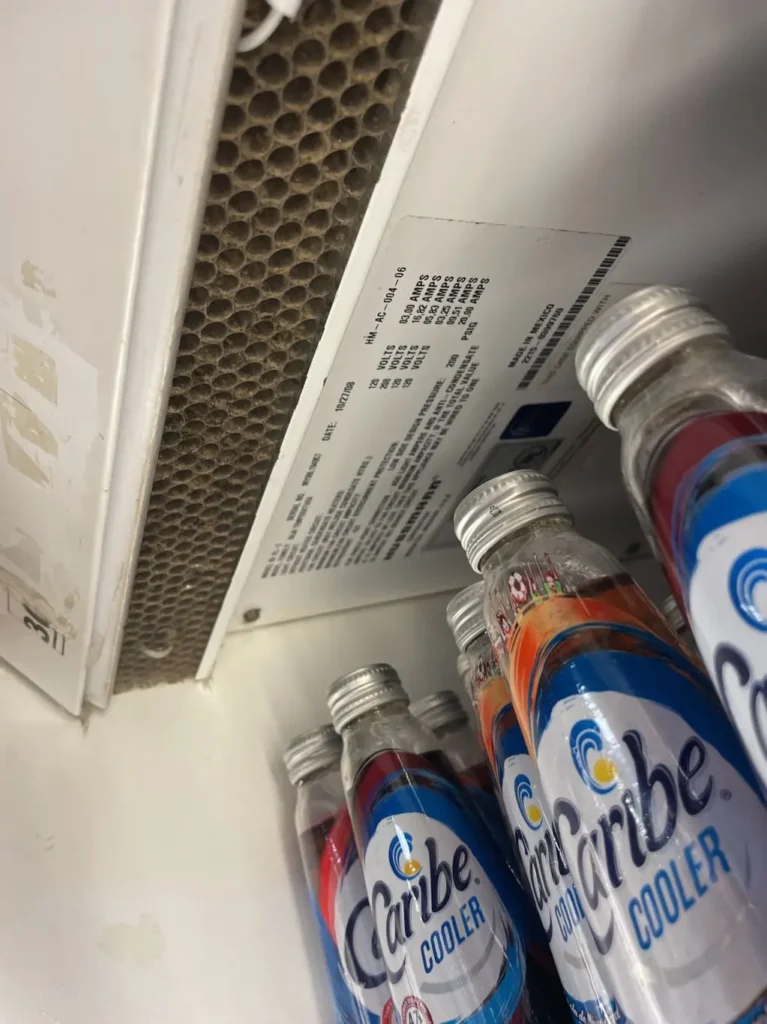
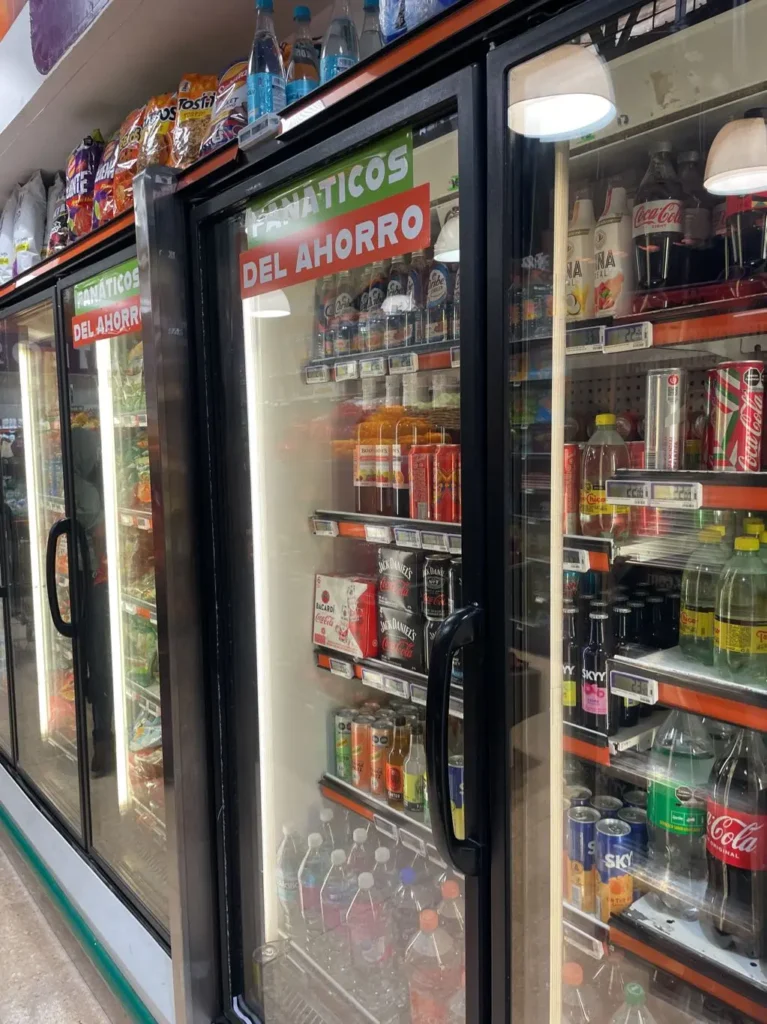
A real one, from last month. Hussmann RL-2 reach-in (My fictitious test location) Victory Markets Hartford.
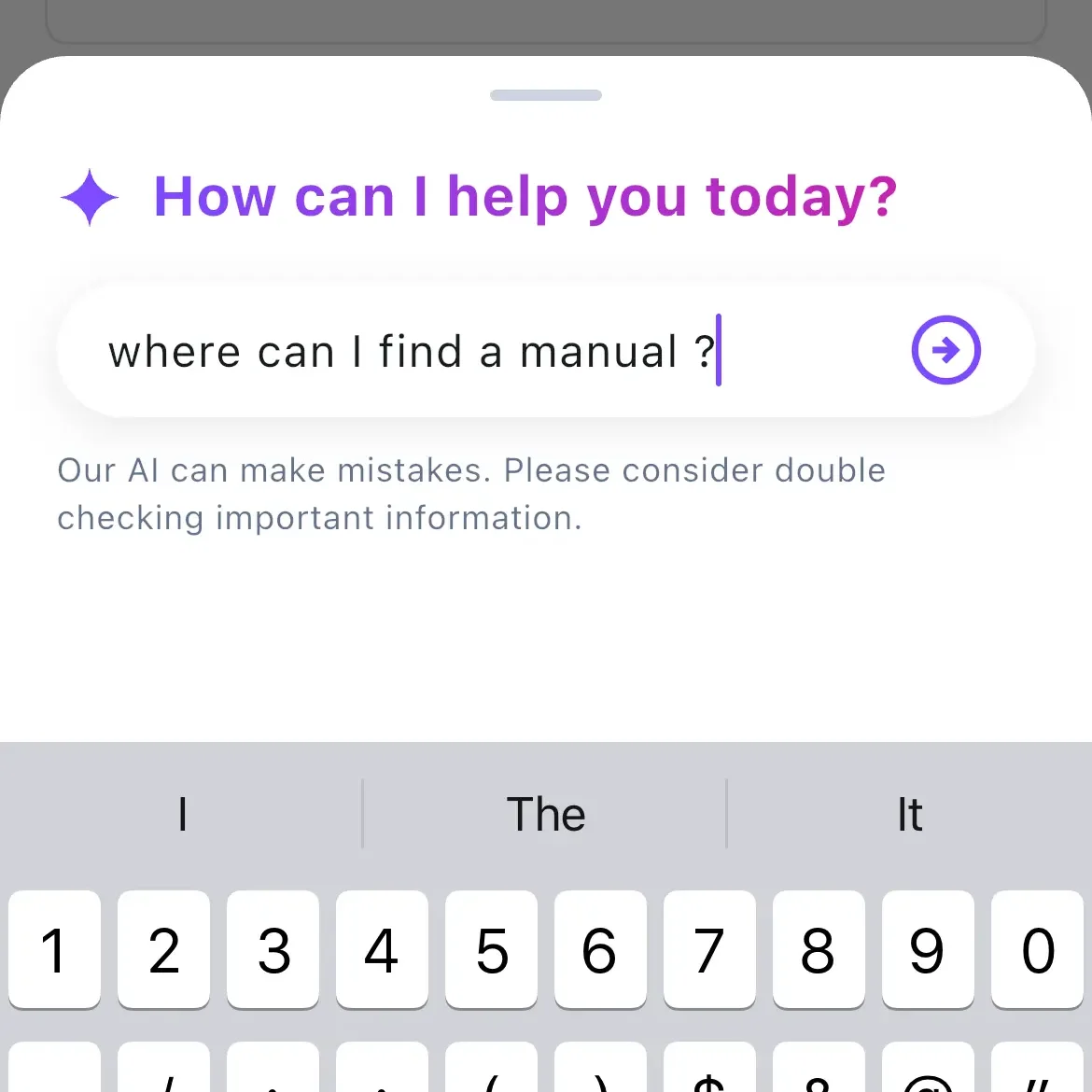
The question: “Do you know where I can find a manual?”
Wizzy came back with the manual on Hussmann’s site and Parts Town for the technical data sheet. Then, without being asked:
Looking at the photo you took, I spotted a few more details you might want to add to the record.
The install date could be 11/25/08, as that’s the date listed on the nameplate.
There’s an identifier, HM-AC-004-06, in the top right corner of the label that looks like a perfect fit for the Tag number.
Does that help you get this record wrapped up?
Asked for the link; it gave the link — then noted the only field still open was a third-party system ID, and said the record was looking solid. Asked to put the manual link into the notes; it did that too.
Most software answers the question you asked. This one finished the job.
You don’t have to memorize serial code hidden messages
Not machine learning. Machine knowledge.
Machine learning describes how software gets built. That’s our problem, not yours.
What matters is what the app shows up with — and Tag Wizard now shows up knowing equipment.
Tag Wizard knows a refrigeration rack from a pallet rack. Both are in your store. Both get called a rack.
Only one of them holds regulated refrigerant and shows up in an EPA audit.
A generic asset tracking app can’t tell them apart, which is exactly why generic asset tracking apps produce equipment records nobody trusts.
That’s the difference between a form with a camera bolted on and an asset tagging app that recognizes what it’s pointed at.
AI nameplate scanning reads the plate.
Machine knowledge is what happens next: knowing which fields this class of equipment actually needs, which numbers look wrong, and what a serial number is telling you underneath the string.
Serial schemes carry build date and plant of origin in the manufacturer’s own code. Every manufacturer does it differently. Nobody should have to memorize thirty of those, and now nobody has to.
What Wizzy works out from a nameplate:
- Serial number decoding — build date and plant of origin, in the manufacturer’s own scheme
- Model family and specifications — including unit weight
- Manuals and parts sources — found, linked, and dropped into your notes if you ask
- Equipment classification — you get the fields this asset needs, not the ones it doesn’t
One tap, and asset data collection is in the record
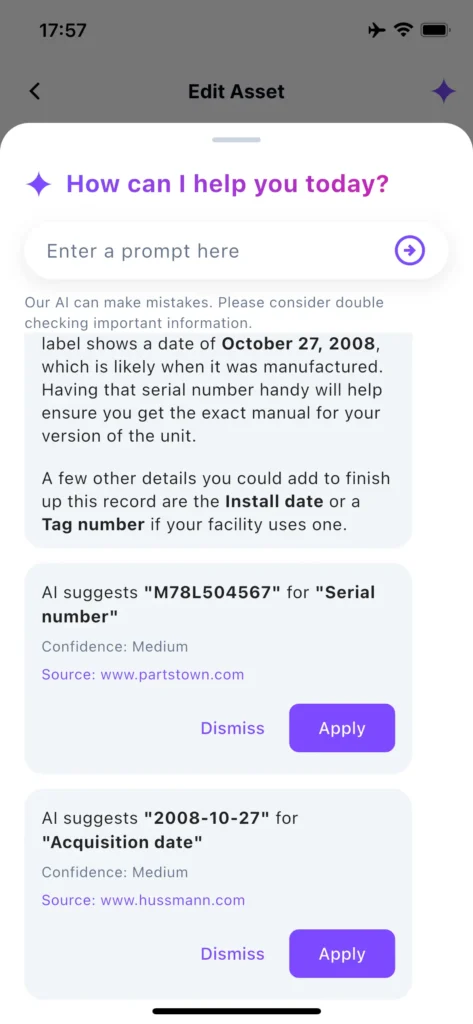
When Wizzy notices something, it doesn’t write it. It offers it, and you tap Apply. One suggestion, one attribute, one decision. Three suggestions mean three separate taps.
That small design choice does two things at once.
And your audit trail builds itself. The tap and the record of the tap are the same event, so every field carries its own history — what was suggested, who applied it, and when. When an EPA audit asks where a full charge figure came from, the app filled it in was never going to be a good answer. Suggested from the nameplate photo, applied on site by the technician, dated is one.
This is what “people decide, AI follows through” looks like as a button rather than a slogan. Most AI features ask you to trust them. This one shows its work.
Tag Wizard ✨ You take one picture. We do the rest.
It keeps working after you walk away
Most AI in this category fires only once. Photo in, fields out, done. Whatever it missed on that first pass stays missed.
Most AI in this category fires once. Photo in, fields out, done. Whatever it missed on that first pass stays missed.
Wizzy doesn’t stop there.
Once the image is captured and sorted, it keeps going (decoding the serial number, pulling model family and specifications, finding the unit weight, locating the manual and the parts source) and comes back with what it found.
The record you open tonight is more complete than the one you left the site with. The first pass gets the plate. Every pass after that goes deeper.
Finish the record wherever you are
The paperwork doesn’t follow you home anymore.
This is the one our own users flagged before we understood it ourselves.
The photo still has to happen on site.
Boots on the floor, ladder against the wall — no app changes that. But finishing the record no longer does. Techs are working with Wizzy from the dining room table, in the truck, over lunch.
Assembling the facts when they’re comfortable, not while standing in a cold aisle with a phone in one hand and a flashlight in the other.
Every asset tagging tool ever built assumed collection and completion happen in the same place at the same time. They don’t have to.
It’s the same shift that already happened in the cab of the truck.
There used to be one guy at every service company who knew the routes — which streets backed up at four, where the loading dock was, how to get on the roof at that one store.
Then the phone started riding along and telling you before the turn, and nobody had to carry the map in their head anymore. The driver didn’t get worse.
He got faster, and stopped arguing about the exit. Probably saved a few marriages along the way.
Nothing like that ever showed up for the commercial world.
The tech still carried all of it — and when he couldn’t, the paperwork followed him home and took the evening with it.
We’re not replacing what you know. We’re replacing what you’d otherwise have to look up.
Your physical assets stop being a pile of parts
Also new: link condensers to evaporators, racks to the cabinets they feed.
As far as we know, nobody else does circuit-level mapping at the point of capture. That may change eventually. Today it’s ours.
A flat asset list tells you what you own. It doesn’t tell you what’s connected to what — and connection is where the real answers live.
“Condenser 3 is down” means nothing until somebody knows which cases it feeds, and that answer usually lives in one technician’s head until he retires.
It’s also why we don’t ask for refrigerant type at an evaporator. The charge belongs to the system, not the component. A tool that understands the relationship can leave the field out on purpose.
Linking stays optional.
Use it where the connection is obvious, skip it where it isn’t, come back later. And Wizzy proposes most of them, so nobody has to walk the building with a schematic first.
Every field shows its history
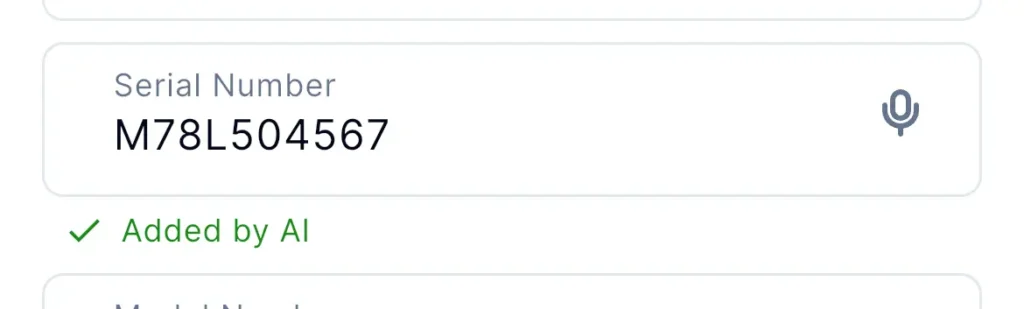
Each value in a record now carries where it came from — extracted from a photo, suggested by Wizzy, or entered by a person — plus who applied it and when.
When someone asks where a number came from, the record answers.
Team synchronization is especially important for large businesses.
Facility managers, technicians, compliance teams, and regional leaders may all need access to the same data.
Tag Wizard supports smarter workflows by keeping users aligned around shared records rather than competing spreadsheet versions.
Administrators can detail smarter asset tagging rules, naming structures, and required fields so the business can manage equipment consistently.
The technology transition made the record mandatory
Under the AIM Act’s Technology Transitions Program, new products and equipment in the refrigeration, air conditioning, and heat pump sectors that use HFCs must meet GWP limits for their subsector — and must be labeled.
That label carries the refrigerant designation, the manufacture date, the charge size, and the date of charge.
Replacement components using higher-GWP HFCs carry their own label marking them for servicing existing equipment only.
EPA has effectively defined the minimum data set that must be physically attached to every covered unit.
This means it has also defined the floor for what any defensible asset record has to contain.
The transition is what makes it operationally hard.
You’re running mixed fleets — legacy HFC equipment beside new low-GWP systems, plus service parts that are legal only for existing equipment.
That Hussmann in the example above holds R404A and was built in 2008. Exactly the kind of unit you need to find by store and by system, without reconstructing it from memory.
Ordering the wrong replacement component or installing a restricted system is a compliance error, and it starts at the asset record.
Tag Wizard captures refrigerant type, full charge, appliance category, and install date at the moment of tagging, so the compliance record and the asset record are the same record.
No second system. No reconciliation.
Add everyone. It costs nothing.
Tag Wizard is priced by location, with unlimited users.
This is a product decision, not a billing decision. Per-seat pricing would break the whole idea.
Capture should move to whoever is already standing in the building — the store manager, the facilities coordinator, the salesperson walking a new account, the first-week apprentice.
The moment each of those people costs money, somebody starts rationing logins, and you’re back to routing every field inspection job through the two people with access.
So add them. The store team, the contractor, the regional manager who wants to spot-check. How many people are tagging should be limited by how many people you have — not by what your asset tracking software charges.
Where it earns its keep
Grocery and Food Retail
The deepest regulated-equipment density of any format, and the fastest-decaying records — cases swapped mid-season, departments remodeled, banners acquired.
Store-level staff can capture, because reading a nameplate isn’t refrigerant handling.
For operators managing physical assets across fleets of stores, asset tagging systems built around barcode labels or NFC tags can also improve inventory discipline.
Data Centers
CRAC and CRAH units, chillers, generators, UPS, switchgear — installed by different contractors across different build phases and documented in different places.
One structured asset inventory instead of five partial ones.
That matters even more across multiple sites, where better records improve asset visibility for maintenance and planning.
The global asset tracking market is projected to reach $36.3 billion by 2025.
Tag Wizard ✨ You take one picture. We do the rest.
Healthcare: A Lot of Buildings, Not Enough Equipment People
The hospital campus is the obvious one. It isn’t the hard one.
Hospitals
We do the mechanical plant. Chillers, air handlers, cooling towers, boilers, and the refrigeration serving pharmacy, lab, and food service — the equipment running behind the walls.
It’s the equipment The Joint Commission asks about.
Environment of Care standards require a documented inventory of utility system components along with records showing they’ve been inspected, tested, and maintained.
A surveyor can ask to see it, and “we’re rebuilding it” is a finding.
It’s also the worst-documented equipment on most campuses.
Clinical equipment gets tracked because it moves and it’s expensive.
The plant doesn’t move — so it gets documented once at commissioning and then drifts through renovations, tower additions, contractor turnover, and thirty years of partial replacements.
The drawings say one thing, the mechanical room says another, and the person who could reconcile them retired.
And you can’t cram for a test with no date on it. Somewhere in a three-year window, surveyors walk in.
Most organizations respond with archaeology — pulling drawings, walking mechanical rooms with a clipboard, reconciling three spreadsheets and one guy’s memory.
Do it as a habit instead, and the archaeology stops. When surveyors arrive, you’re not preparing. You’re printing.
Senior living and skilled nursing
Small buildings, lots of them, and one maintenance director covering four properties.
Rooftop units, boilers, a commercial kitchen, walk-ins and freezers, ice machines in every wing, laundry, and a generator that has to start when the power goes. No facilities engineer. No CMMS. The equipment list lives in a binder, a spreadsheet, and mostly in the head of the guy who’s been there eleven years.
The stakes are residential. A chiller down in an office building means discomfort. A chiller down in memory care in August is a conversation with the state and with families.
Outpatient and ambulatory
Surgery centers, imaging, dialysis, urgent care, physician offices. Dozens of sites, some of them a suite in a strip center, almost none with facilities staff on payroll.
The equipment matters more than the square footage suggests: vaccine and specimen refrigeration with documented temperature requirements, dialysis water treatment, rooftop units nobody has looked at since the buildout, sterilizer support, a backup generator that exists because a procedure can’t stop halfway.
Rolling stock
Not everything stays in a building. Ambulances, fire apparatus, mobile imaging, medical transport, mobile clinics — each one a package of tracked equipment. Refrigeration for drug storage, generators, HVAC, compressors, power systems. And the whole package moves, gets swapped between units, and comes back from the shop different than it went in.
Tag the vehicle as the location and the equipment underneath it, and you know what’s on Medic 4 today. When the module rotates to a different chassis, the record travels with the equipment.
Why is this the part we’re excited about?
In a hospital, you can send a technician. But across four senior living properties, twelve outpatient sites, and a fleet of thirty ambulances — you can’t.
There isn’t one, and there won’t be.
The person standing in front of that equipment is a maintenance director stretched thin, a practice manager between patients, a fleet mechanic who knows chassis and not refrigeration.
They can all take a photo. What they can’t do is know what they’re looking at.
So the expertise had to move into the app. That’s what Wizzy is for, and it’s why this stopped being a hospital product and started being a healthcare one.
It classifies, so nobody has to learn a taxonomy.
A practice manager photographing a vaccine refrigerator doesn’t need to know it’s a different asset class than the rooftop unit outside. Wizzy knows, and asks each one only what it actually needs.
It catches what an untrained eye can’t.
A value that’s wrong for that class of equipment doesn’t look wrong to someone who’s never seen a hundred of them. Wizzy flags it in the moment — which is the difference between distributed capture producing a usable record and producing confident garbage. A bad inventory is worse than none, because you trust it.
It decodes age, which is what a maintenance director is actually asking.
Serial numbers carry build date. Across four properties, that turns a pile of photos into a capital plan: here’s every unit past twenty years, here’s what fails first, here’s the budget conversation.
No engineer required.
It finds the manual at 2 a.m.
Boiler down in a skilled nursing facility on a Sunday, and the guy on site has never worked on this model.
Wizzy has the documentation and the parts source before he’s back to the truck.
It keeps working after the photo.
The practice manager captures between patients, walks away, and comes back to a record Wizzy has been filling in — serials decoded, specs pulled, manuals attached.
And it makes twelve people produce one format.
This is the one that decides whether any of it works.
Twelve sites captured by twelve different people used to mean twelve versions of the truth.
Wizzy asks the same questions of the same equipment every time, so the records match — not because everyone got trained, but because the app carries the standard.
That’s the shift. Documentation used to require sending someone who knew the equipment, which meant most of these buildings never got documented at all.
Now it requires someone who’s already there.
They take the picture.
Wizzy handles the part that used to take 20 years.
Service Contractors: The Whole Team Can Tag
You didn’t hire a data entry department. You hired technicians, and every hour one of them spends copying a model number is an hour of the most expensive labor in the building doing work that requires no license.
That’s the constraint this was built against. The way out isn’t a faster form — it’s more hands.
The first visit decides the account
You win a new customer. Now you’re responsible for equipment you’ve never seen, installed by somebody else, documented by someone who doesn’t work there anymore.
Traditionally, that means scheduling a survey (which means waiting on the two or three people who can do it) which means weeks between the handshake and the first productive service call.
That gap is where new accounts curdle. The quote goes out on guesswork. The first PM cycle runs against an inventory nobody trusts.
Your customer’s first impression is a truck arriving unprepared for equipment you should have known about.
Send whoever’s already going.
The salesperson who won the work can walk the mechanical room that same week.
Reading a nameplate isn’t refrigerant handling and requires no certification. Junior techs can capture.
Apprentices can capture. The customer’s own facilities coordinator can capture.
Days from signature to a usable equipment list, instead of weeks.
📱 Download Tag Wizard
Every service call makes the record better
The bigger shift isn’t onboarding. It’s what happens after.
Your people are already in these buildings. Every PM, every repair, every 2 a.m. call, somebody is standing in front of equipment with a phone in their pocket.
If capture takes one photo, it happens.
If it takes a form, it doesn’t — the job always matters more than the paperwork, and it should.
The inventory stops being a project you fund and becomes a byproduct of work you’re already doing. Nothing to rebuild, because nothing decayed.
Two jobs, and you need both
Here’s what stopped everyone from doing this before: five people produce five different records. And a bad inventory is worse than none, because you act on it.
Tag Wizard is the discipline.
It knows the attributes, the classification, and what a record for this class of equipment has to contain. It’s the part that says this is a walk-in evaporator — here’s what belongs in this record, and here’s what doesn’t. That’s what makes your first-week apprentice produce a record your twenty-year tech recognizes. Not training. Structure.
Wizzy is the explorer.
It goes looking (through manufacturer documentation, spec sheets, parts catalogs) and comes back with what it found. Decoded serials carrying build date and plant of origin.
Model family and specifications.
The manual and the parts source, attached to the record instead of living in a phone call to the supply house.
Neither one works alone.
Curiosity without structure is a fatigue machine — it returns forty things about a model number and hands you the sorting problem, which is worse than not asking.
Structure without curiosity is just a form.
Together, Wizzy can bring back everything it finds because Tag Wizard already knows which eleven things belong in this record and which twenty-nine don’t.
That’s why you can widen the net without lowering what comes back.
And that’s why it keeps improving after your tech leaves the site — the record you look at tonight is more complete than the one that drove away.
Every value still shows its history: what was suggested, who applied it, when. Which matters the first time a customer disputes a scope.
Not data fatigue. Data usability.
What it does for the business
Estimators quote from real model numbers.
No more scope corrections after the fact, which is where margin and goodwill both go.
Techs stay on billable work.
Documentation stops competing with service calls for the same scarce headcount, and there isn’t more headcount coming.
New hires contribute in week one.
The app carries the standard, so onboarding is one photo, not six months of shadowing.
Sites get documented that never justified a visit.
The small accounts, the satellite locations, the one rooftop unit across town.
Knowledge stops walking out the door.
What the retiring tech knew about which rack feeds which case ends up in the record instead of leaving with him.
Your customer sees what your tech saw.
Same data, same photos, no reconciliation between field notes and the invoice.
📱 Download Tag Wizard
Q&As
What is Wizzy?
The AI agent inside Tag Wizard. It reads what you photograph, knows what it’s looking at, and helps you finish the record.
Why is it called Wizzy?
It’s the small, quick version of the Wizard. Tag Wizard is the app. Wizzy is who you talk to inside it.
Is Wizzy going to do my job?
No. It doesn’t climb the ladder, doesn’t turn the wrench, and doesn’t make the call on what’s wrong with the equipment.
It handles the details that follow you home.
How do I open it?
Tap the sparkle icon on any asset — upper left corner of the asset record. In the field, techs often use the mobile app to scan in or review that record before opening it.
What can I ask it?
Anything, in plain language — the way you’d ask the guy who’s been doing this twenty years.
- “Where can I find a manual?”
- “What’s this serial number telling me?”
Does it only answer what I ask?
No. While it’s answering, Wizzy looks at the photo you took and points out what else is worth adding — an install date on the plate, a tag identifier in the corner, a value that looks wrong for this class of equipment.
How smart is it about equipment, really?
It knows a refrigeration rack from a pallet rack.
That sounds obvious until you’ve watched generic software confuse the two.
How do I know when a record is finished?
Wizzy tells you. Not “you have empty fields” — more like: the only thing still open is a third-party system ID; otherwise this record looks solid.
Does Wizzy change my data on its own?
Never. Wizzy suggests; you tap Apply.
Each suggestion gets its own button and lands on one specific field. Ignore all of them and tag exactly the way you always have.
What if Wizzy is wrong?
Sometimes it will be. Any system making suggestions about real-world equipment gets some wrong.
That’s why nothing writes without Apply, and why every suggestion and decision lands in the record’s history.
The point isn’t an AI that’s never mistaken — it’s one that raises the question while you’re still in front of the equipment.
Can I see what the AI suggested versus what a person entered?
Yes. Every field shows where the value came from.
Can I use Wizzy away from the site?
Yes, and most people end up doing exactly that. Capture the photo on site, finish the record wherever you are.
Do I have to use linking?
No. It’s optional. Assets captured without relationships are still complete assets.
Do I need to know the system layout before mapping?
No. Wizzy proposes connections based on what’s already been captured nearby.
Will this slow down experienced techs?
No. Wizzy stays quiet when the record looks right.
Does it work on non-HVAC/R equipment?
Yes. Generators, elevators, registers, slicers, vehicles, and non-serialized assets like drains and lights.
Do I have to retag what I’ve already captured?
No. Links and Wizzy’s continued work apply to existing records, and the workflow respects existing assets instead of creating silent duplicate records.
How is it priced?
By location, with unlimited users. Adding people costs nothing.
Does my data still export?
Yes — structured, exportable, audit-ready, now carrying relationships and field history alongside the asset data, and usable as an asset register for ongoing recordkeeping.
📱 Download Tag Wizard
You take the picture. We (do the rest) to help finish the job.
Our promise has always been simple: one photo, we do the rest.
The catch is that “the rest” isn’t one thing.
Ask Julio what the rest means, and you’ll get one answer. Ask Sam, or Jonathan, or Justin, or Wade, and you’ll get four more.
One of them wants the manual link in the notes before he leaves the site. One wants the serial decoded so he knows what he’s actually looking at.
One wants the whole record closed out before he’s back in the truck. One wants to know what’s connected to what.
They’re all right. They’re describing different jobs, and better field capture supports asset management by improving asset record feeding.
Which is why we’re never finished. Every time we deliver somebody’s version of the rest, somebody else describes a version we haven’t built.
The techs using this tell us it’s great the way it is. We appreciate that, and we don’t accept it — because good enough for one guy on one job isn’t good enough across a crew, a chain, a portfolio.
You take the picture. We’ll keep pushing on the rest.
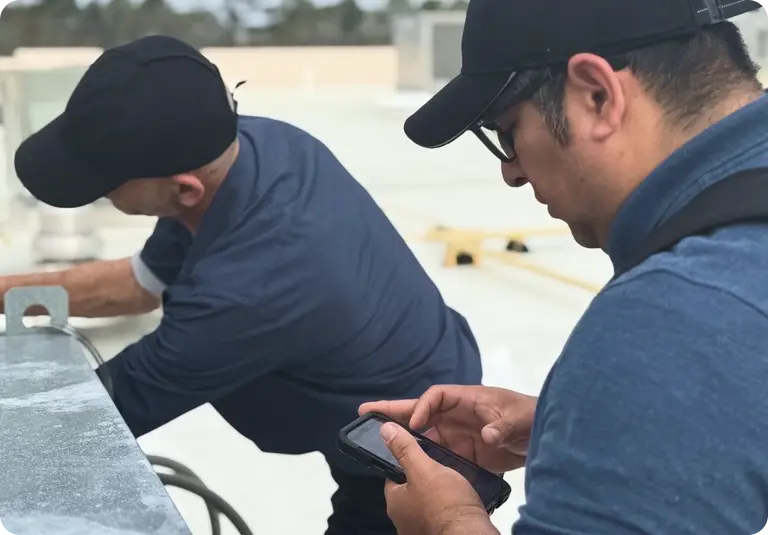
Try it.
- Download Tag Wizard and use it for asset identification on a system, not just an asset. Or grab a photo from your photo library
- Point it at your worst nameplate (rusted, greasy, thirty years old, half behind a bracket) and connect the physical tag to the digital record. Save the asset.
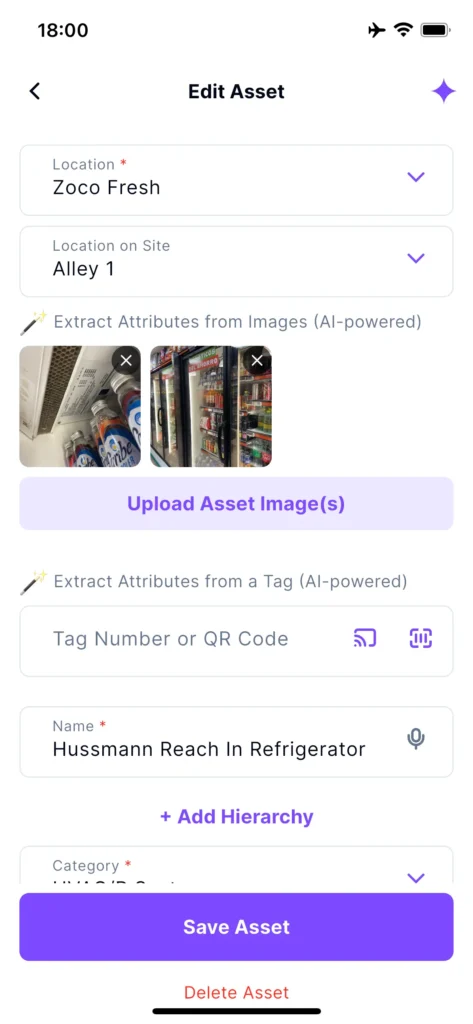
- Once the asset is saved, navigate back to the asset, and in the upper-right corner you will see a purple diamond icon; click it and ask Wizzy something you’d normally have to look up. Be prepared to be amazed.
- Invite five people who’ve never had a login.
Tag Wizard is a mobile asset tagging and equipment tracking app for HVAC/R and mechanical equipment.
A user photographs an equipment nameplate; Tag Wizard’s AI reads the plate, identifies the equipment, and builds a structured asset record — capturing manufacturer, model, serial number, refrigerant type, full charge, location, and other fields relevant to that class of equipment.
Wizzy is the AI agent inside Tag Wizard.
It decodes manufacturer serial numbers, locates manuals and parts sources, identifies missing or questionable values, proposes links between connected equipment, and continues researching after the initial capture.
Wizzy suggests; the user taps Apply. Every field records where its value came from, who applied it, and when.
Tag Wizard is used by grocery and food retail chains, hospital and healthcare facilities teams, data center operators, commercial property managers, and HVAC/R service contractors — typically to build refrigerant compliance records under the EPA’s AIM Act and Section 608 requirements, to prepare for audits and accreditation surveys, and to maintain equipment inventories across multiple sites.
Tag Wizard is tag-agnostic, working with existing barcodes (which require a direct line of sight to scan), QR codes, which can be scanned with any smartphone camera, RFID (super excited about this), which can be read from a distance without line of sight, NFC, which is read at distances of a few centimeters, or no tags at all for critical assets.
GPS tags report real-time location of mobile assets.
Data is structured, exportable, and designed to feed CMMS, compliance, and reporting systems. Pricing is by location, with unlimited users.