

Two Skeptical Techs, Two Hours of Training, and the Question Every Asset Tracking System Gets Wrong
I went to Charlottesville first because I wanted Tag Wizard’s first real test of our asset tracking system to happen somewhere that meant something to me.
In practice, that system is a field-mobile way to identify and track HVAC/R and refrigeration assets across multiple locations without manual entry, duplicate records, or guesswork—the kind of structured asset data large facility operators need before a CMMS, field service platform, or compliance workflow can do its job.
I’ve been reading presidential biographies in sequence from Washington forward, and with the 250th celebration of the Declaration of Independence underway, it felt like the right place to test an idea built for work that has to hold up over time.
It was a great day. I did a walk-through, a leak inspection, and used the time to tag assets.
It worked really well—better than I expected. It never crashed, and I started to feel some relief that not only would it work, but it would work at scale.
If a knucklehead like me could tag 100 assets in 3 hours, imagine what someone who knew what they were doing could accomplish.
For grocery chains, commercial real estate teams, data center operators, and others responsible for critical HVAC/R equipment, that speed and accuracy matter because old asset-tracking methods are slow, expensive, error-prone, and harder to defend under EPA, CARB, and sustainability reporting pressure.
So I set off for South Carolina to meet the two guys who’d actually be doing the work.
It was a 5-hour drive; I went past Quantico and the farms where Jefferson, Madison, and Monroe all lived.
I had flown in the day before and wanted to test things before seeing the two guys.
Simply put, this is a look at HVAC asset monitoring, what breaks in existing asset-tracking systems, how tagging supports compliance and cold-chain sustainability, and where AI-enhanced asset tagging starts to change the economics of getting trustworthy equipment records in the field.
→ Read the full Year One case study
They were not thrilled to see me.
Fair enough.
They’d just spent seven months building their own way to track assets across a few hundred grocery stores — and made it less than 10% toward their goal, a real, honest effort, done by two people with no shortcuts and no outside help.
It got them 2,600 assets logged. And now here I was, with an app on a phone, telling them I could do better.
I gave them two hours of training. That’s it. Two hours, on a Tuesday, and then I left them to it.
I want to tell you what happened next, but first I want to tell you why I was standing there in the first place — because the two techs weren’t the real story.
The real story is a problem I’d been circling for 2 years, and a bet I wasn’t sure I’d win.
→ Read the full Year One case study
Tag Wizard ✨ You take one picture. We do the rest.
The problem nobody says out loud
An asset tracking system accurately identifies and tracks assets across multiple locations by fitting each asset with a unique identifier, with the captured data transmitted to a centralized database, without forcing teams back into manual entry, duplicate records, or guesswork.
For grocery chains, commercial real estate operators, data center teams, and anyone responsible for critical HVAC/R and refrigeration equipment under rising compliance and sustainability pressure, that standard is harder to meet than most software demos admit.
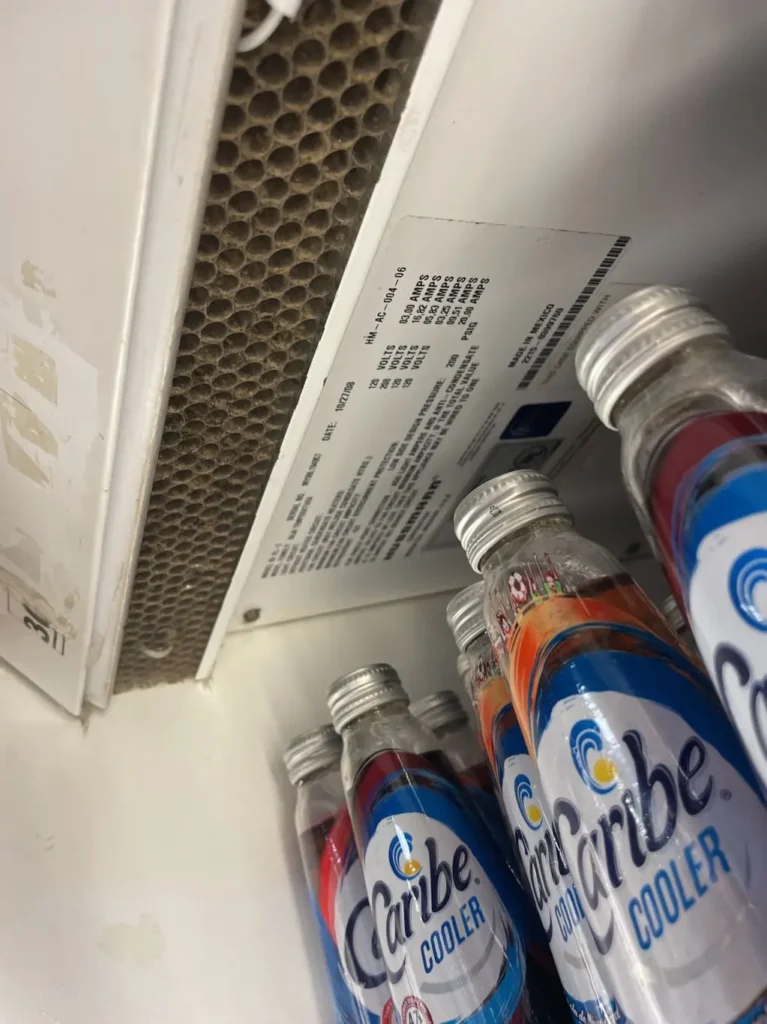
Also, there are so many varieties that it takes a skilled tradesperson to decipher the codes and label things properly.
Carl Sagan was terrific at turning tough scientific complexities into easy-to-understand narratives. He followed a serious commitment to the scientific method.
He has a great story that resonates: “Imagine a friend who insists there’s a dragon in his garage — invisible, floating, breathing heatless fire, leaving no footprints.
Every test you propose to verify it, the friend has an explanation for why it won’t detect the dragon. Sagan’s punchline applied to Assets:
Sagan’s punchline applied to Assets:
“What if you tag something and someone else can’t see it because it’s labeled wrong or identified incorrectly (so the thing that you’re relying on for your cost management is missing from the CMMS system that’s the heartbeat of your company’s insights to what’s happening)?
This happens all the time.”
This reminds us that the deepest equipment data available, decoded automatically, looks exactly like this claim. If the data only lives inside their platform and you can never independently verify it against reality, what’s the difference between “the deepest data available” and no data at all?
Here’s the thing about identifying assets across many locations and figuring out how to track them once you’ve found them: everyone ends up choosing between two bad options.
- Option one is what the team originally did — build it themselves.
You get something that mostly works, run by whoever’s willing to learn it, until the day it no longer scales and you’re stuck.
- Option two is buying an asset tracking system built for somebody else’s problem — a generic inventory tool for warehouse pallets or IT hardware, built around a company selling barcode labels or a reader, a computer already understands.
That works fine until the asset in front of you has no readable label at all.
Point it at a rooftop condenser with an electric disconnect over the nameplate, and the system has no idea what it’s looking at — so neither does the person holding the scanner.
Manual data entry creeps back in the moment the tech stops trusting what the system tells them, and once that happens, the whole reason you bought the system is gone.
- Option three, and it’s the one we built: software with exactly one job — identify and track the equipment.
Nothing else bolted on. Nothing else diluting it.
Most of the things we found followed the same pattern: a fresh coat of paint on old plumbing.
The spreadsheets were costing people more than $4,000 per location to tag, and not many companies have the resources to execute at that level.
As the former founder of a compliance app, I saw it firsthand every day, and the whole team was uneasy: without the data, the app we built was useless —but at what expense?
Really, how could what we were doing cost so much to get underway?
We had a really committed client, and during onboarding I found out they spent nearly $7 million collecting asset data, and the project took 20 months.
When I heard that seasoned engineers were touring sites to gather data, it was an uncomfortable realization that it would cost 15x more to get the data collected than it would be to manage it.
Something had to give.
I don’t blame anyone for wanting to own that decision.
But I watched what those 20 months actually cost them, and it confirmed something I already suspected: the bottleneck was never data collection, and some had tried photos so office people could sync and agree on naming or labeling.
It was everything downstream of the photo — matching it to the right equipment, catching the duplicate, naming it the same way twice.
Nobody had built a way to separate that judgment work from the person holding the camera.
This is the part most large operators are feeling now: traditional asset tracking in HVAC/R environments is expensive, slow, error-prone, and hard to scale, just as EPA, CARB, the AIM Act, and broader ESG demands make trustworthy records more important.
Add the HVAC labor shortage, and bad asset data stops being an admin problem and becomes a compliance, operations, and sustainability problem.
What follows covers HVAC asset monitoring where existing asset-tracking systems fail, what has changed under today’s regulatory pressure, why asset identification is so unreliable in the field, how sustainability goals in cold-chain and refrigeration operations raise the stakes, and where AI-enhanced asset tagging fits.
📱 Download Tag Wizard
The Pulse and Heartbeat Matter
Every number in this piece (the 16.2×, the 30,000 assets, the $9.30 that became less than a dollar) is a pulse.
You can take it from across the room. It tells you something is alive in there, working, moving faster than it used to. What it doesn’t tell you is what’s actually beating underneath it.
That part isn’t a number. That part is two guys, most days, standing in front of a piece of equipment nobody else is thinking about right then.
One of them sent me something unprompted, a few months into using the rebuilt product — not because I asked for a testimonial, but because he wanted to say it. I’m going to let him say it himself, because I couldn’t write this part better than he did:
“Data plates are often dirty, faded, damaged, hidden behind panels, or mounted in difficult-to-access locations.
Manually recording model numbers, serial numbers, and equipment information inevitably introduces human error, especially when documenting large numbers of assets.”
That’s Sam. That’s the pulse of the actual problem, from the person who has to solve it every day, not from a slide.
And here’s the part that surprised even me:
“One benefit I did not expect was how much I would learn throughout the process.
As I spent more time using Tag Wizard, reading data plates, documenting assets, and learning equipment classifications, I developed a much deeper understanding of refrigeration systems, HVAC equipment, electrical infrastructure, generators, transfer switches, and other facility assets.
In many ways, Tag Wizard became an educational tool in addition to an asset management platform.”
I didn’t build a training tool. I built something that removed the requirement that you already had to be trained. I didn’t predict that the byproduct would be someone getting trained anyway — just in the other direction, by doing the work instead of studying for it first.
The other half of that heartbeat, the one already on the record in the case study itself, said something shorter, in the first week:
“This is going to make us faster and more accurate.
The picture does the work — everyone on the team knows exactly what we’re looking at.
We’re going to cover a lot more ground.”
Two different people, two different ways of saying the same thing: the pulse only reads the way it does because the heartbeat underneath it is real, and it’s theirs, not mine.
→ Read the full Year One case study
What doesn’t work?
“Extraordinary claims require extraordinary evidence.”
Carl Sagan
We took the approach that if we were going to solve big problems and the claim was big enough to build a business on, the proof had to be just as big.
A chart isn’t proof. It’s a picture of a claim.
I’ve watched a lot of teams try to solve this before they found a real answer.
Some of what’s out there is well-funded and genuinely good at the job it was built for.
That’s not the same as being built for this job, and it’s worth being specific about where each one actually breaks.
| Approach | What They’re Actually Selling | The Pitch | Where It Actually Breaks | One-Line Take |
|---|---|---|---|---|
| One-time audit and survey tools | Speed for a single project | “One photo, and the survey’s done” | Fast because it’s shallow — one photo drops into one field, no cross-check against the actual equipment, no duplicate flag across surveys. A digital clipboard. | The White Castle at 2am — no one admits being there, yet the lights are always on. |
| Ecosystem-locked enrichment platforms | Access to their walled garden | “The deepest equipment data available, decoded automatically” | Only fires if there’s a readable serial to look up. No serial, no match — a parts-lookup table with a UI. | The data motel — data checks in and never checks out. |
| Features bolted onto a bigger platform | One faster step inside software you already pay for | “Image capture in about ten seconds” | Only works with a clean shot of the nameplate. It’s OCR, commercial since the 1970s — reading a label isn’t intelligence. | Same people who put a Blaupunkt stereo in their AMC Pacer. |
| Lightweight tagging utilities (RFID, QR, barcode) | A code stuck on the equipment | “Simple, fast tagging” | Carries no equipment intelligence of its own — just a pointer to whatever a person already typed into a database. | Selling a wooden pencil as a “biocompatible, hand-powered graphite applicator with a manual mistake-undoing module.” |
| Spreadsheets | Nothing — free, and that’s the whole appeal | “It’s free, we already have it” | Honest about what it is: a ledger. Format unchanged since 1979; stops scaling once more than a couple people touch it. | The oldy but goody. |
Here’s the part that took us longest to see clearly: none of these companies are incentivized to solve the actual problem, because solving it doesn’t sell more of what they sell.
Broader asset management depends on visibility that helps reduce loss and theft of equipment.
An enrichment platform makes money keeping your data inside its ecosystem, so portability was never the pitch. A field-service platform makes money on the whole workflow, so the capture feature stays a checkbox, not a product in its own right.
Nobody in that chain has a reason to ask whether the premise (a working tag, a known asset type, a person already trained to enter the data correctly) was ever a safe thing to assume.
Even the ones built around a photo still leave every real step to the person holding the phone. Define what the equipment is. Identify it against whatever catalog you’re carrying in your head.
Choose the category. Map where it sits and what it connects to.
And then, after all of that, figure out what actually happens with the record — where it lives, who sees it, whether it ever reaches the system that’s supposed to hold it.
The photo was supposed to be the hard part. It never was. Everything after the photo is the hard part, and that’s exactly the part every one of these tools quietly hands back to you.
📱 Download Tag Wizard
Some of these are well-built products, genuinely good at the job they were designed for.
That’s exactly the point.
None of them were designed to answer the one question that actually matters here: what is this piece of equipment, on its own, without a working tag, without a bigger platform underneath it, without someone already having to know the answer before they’re allowed to log it?
A lot of things can say “asset tracking” on the box, but that only refers to one slice of asset management, and better underlying data improves purchasing and budgeting decisions.
That doesn’t make it the same job, and it won’t prevent downstream problems.
Why couldn’t this wait for operational efficiency?
I didn’t rebuild the product because it seemed like a good idea. I rebuilt it because the ground was moving under everyone doing this work, whether they’d noticed yet or not.
We applied the same standard to ourselves that we just applied to everyone else’s claims:
If it can’t be checked against reality, it doesn’t count. We offer a free pilot as a hypothesis, not a pitch.
The taxonomy is a control, not a style guide. Wizzy’s every suggestion gets checked against the actual equipment, every time.
That’s the scientific method, applied to a company instead of a lab.
We accept that we were biased and were not building Tag Wizard for us.
The economics never worked at scale to begin with.
An asset tracking system also supports better maintenance scheduling through usage data and can reduce inventory maintenance and repair by 18%, which helps increase efficiency as the global asset tracking market is projected to reach $71.55 billion by 2034.
Bringing in a specialized crew to tag a single 50,000-square-foot location has run $3,500 to $4,800 — a real number, not a worst case. Multiply that by a few hundred locations, and the math answers itself before anyone asks the question.
At the same time, the regulatory floor kept rising.
EPA labeling requirements set a baseline for what has to be tracked on covered equipment, and states have been building their own enforcement on top of that. It’s not just a U.S. problem, either — new requirements in the UK and elsewhere are pushing in the same direction: assets have to be identified and quantified, not estimated.
Stronger documentation and audit trails help ensure compliance with ISO 55000 standards while improving transparency and accountability for inspections, audits, and compliance reviews.
A spreadsheet nobody trusts doesn’t satisfy an auditor, foreign or domestic.
And underneath both of those pressures sits a labor problem I don’t think gets talked about enough. There are roughly 425,200 HVAC technicians in this country — that’s the entire pool, across every building type.
About 40,100 openings a year through 2034, and most of that is from people retiring, not from the trade growing.
About 105,000 of today’s techs are 55 or older, carrying the deepest equipment knowledge in the field, and walking toward the door. You cannot hire your way out of that quickly.
Automated maintenance alerts can improve asset utilization, extend asset life, and guide updates from peak operation through retirement when skilled labor is limited. The pipeline is measured in years.
Put all three of those together, and you get a simple, uncomfortable fact: the old way of doing this (a specialist standing in front of every single asset) was never going to keep up, and delayed visibility makes utilization harder to measure and weakens the strategic decisions teams need to make.
Something had to give.
→ Read the full Year One case study
Tag Wizard ✨ You take one picture. We do the rest.
What we came together to build: Asset Tracking Software
No one on this team set out to build another asset-tagging app.
As a matter of fact, another founder of a tagging app had previously been involved in the CMMS world, and after 5 years he hadn’t transformed anything – so I thought: how could we do better?
(Also, I wondered why two of us in the same space ended up in the same place??)
I set out to remove a requirement that never needed to exist in the first place: that identifying a piece of equipment correctly requires a specialist who already knows what it is.
Under EPA Section 608, certification attaches to work that could release refrigerant — servicing, repairing, disposing. Reading a nameplate isn’t refrigerant handling.
It never required the license. It just required the person doing it to already know what they were looking at. So I built a system where that’s no longer true.
You take the picture. The system reads what’s there — and lets you scan an asset identifier when one is present, even when the nameplate’s gone — and turns it into a clean, structured record without anyone needing to know a compressor from a condenser fan.
It keeps everything in one place so users can work from a current list instead of creating records again by hand. It supports the asset lifecycle from acquisition through retirement by integrating planning, acquisition, deployment, monitoring, maintenance, and disposal, not just tagging.
Data capture happens once, at the source, instead of getting typed in twice by two different people trying to reconstruct what somebody saw a week ago.
Feynman had a line I’ve never been able to shake:
You’re the easiest person in the world to fool, so build things that catch you before they catch anyone else.
That’s the actual design principle here, not just a nice quote.
The free pilot only meant anything because we didn’t know the answer going in — if we’d been wrong, we’d have found out for free, in public, fast.
The taxonomy exists so that nobody has to rely on their memory of what they called a piece of equipment last time.
And Wizzy never gets the final word, because the one check that actually matters is a person looking at the real thing in front of them and confirming it matches.
Every one of those is a way of not trusting ourselves too much.
We had already done this once. The first pitch, the loss, watching those two guys spend seven months on something that didn’t get them where they needed to go — that wasn’t free to sit through, and it wasn’t fast.
The rebuild cost more time than I’d planned for, more money than I’d budgeted, and more than a few nights where I wasn’t sure I was actually fixing the thing that broke the first time or just building a different version of the same mistake with better paint on it.
This is where Feynman’s warning actually gets tested, not just quoted.
He was a physicist who spent his career insisting that rigor starts with doubting yourself before anyone else gets the chance to — you’re the easiest person in the world to fool, so you build the trap for your own mistakes before you go looking for anyone else’s.
That’s easy to nod along with in the abstract.
It’s harder when doubting yourself might mean admitting you just spent a year and real money proving nothing.
But there’s a Stoic idea, from Marcus Aurelius, that sits right next to Feynman’s, even though the two of them are separated by two thousand years: do the work as completely as it can be done, commit to it without holding anything back, and then let the outcome be the outcome — without spending anything afterward on blame, of yourself or anyone else.
Not because the outcome doesn’t matter. Because by the time you’re standing there waiting for the answer, blame is just time you don’t have left to spend.
So when I said double the output or don’t, I meant it as the only question that actually mattered. Not “does this look better.” Not “do they like the interface more.”
Double it, or admit the last year hadn’t taught me what I thought it had, and go back to the drawing board — again — with less runway and less certainty than I’d had the first time.
There was no version of this where I talked myself into a soft win, and there was no one left to blame if it hadn’t.
Not the market. Not the account. Not even myself. Just the work, and whether it was actually good enough.
→ Read the full Year One case study
It doubled.
We also built an AI layer into it (and we call it Wizzy) that watches the record take shape and speaks up in the moment, while the tech is still standing in front of the equipment and it costs nothing to fix.
Role-based controls let authorized personnel manage changes while field teams still capture the record. Built-in analytics help teams monitor records in real time and support decision-making from the same workflow.
It flags a compliance gap. It catches data that doesn’t fit the equipment class or assets that lack key identifiers. It proposes a connection between a rack and the cases it feeds, because refrigeration compliance math runs against the whole circuit, not each part hanging off it.
Assignments, updates, and feedback can run through the system, so teams receive alerts while the work is still actionable.
Wizzy proposes. The technician decides. Nothing gets written on the AI’s say-so alone.
That’s the whole idea, underneath everything else: capture is transferable. Judgment isn’t. It never should’ve had to be.
What happened with those two guys?
The rebuild took until February 2026 — longer than I wanted, but I wasn’t willing to hand this account a second version that needed redoing again in six months.
When I came back in March, I didn’t lead with a deck. I offered to run it free. I was confident enough in the rebuild to be willing to be wrong about it, and I said so plainly: if this doubles your team’s output, it becomes a paid relationship.
If it doesn’t, no harm done.
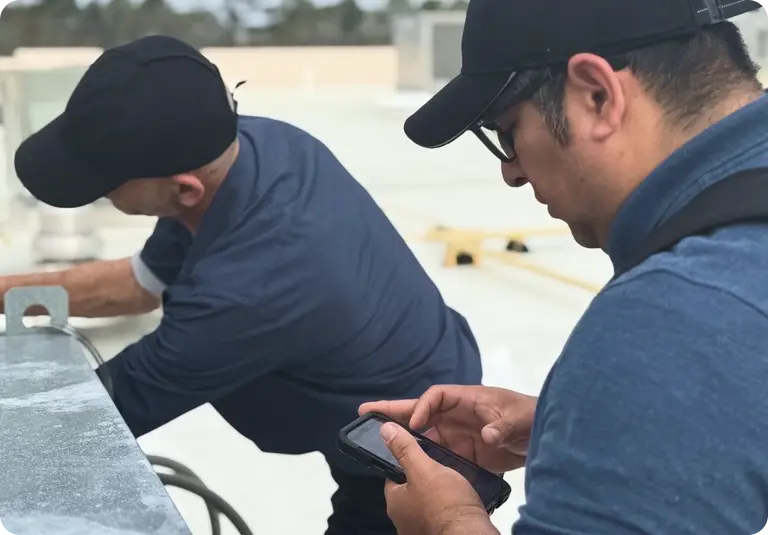
Two hours of training later, in that South Carolina facility, the two of them were working. The skepticism didn’t last past the first week.
Five months in, they weren’t just covering more ground than their old system ever managed.
They’d stopped working side by side to double-check each other, and started splitting up entirely — different stores, same day, trusting the data enough to work independently for the first time since any of this started.
That trust translated into improved asset utilization, and visibility into assets can improve maintenance productivity by 28%.
That’s not a small thing. That’s the actual measure of whether an asset tracking tool works: not whether it’s fast, but whether the people using it trust it enough to stop checking its homework.
Cloud-based asset tracking solutions can increase transparency across locations without adding duplicate work. Real asset visibility isn’t a dashboard with more charts on it — it’s two people willing to split up because they finally believe what the system is telling them.
I wrote up the whole year — the number they started at, the number they’re at now, what changed in between, and what it cost versus what it used to cost to get this done- in an article that documents the real numbers and lessons learned.
It’s what effective asset tracking actually looks like at the scale of a few hundred stores, across industries including manufacturers, and this kind of workflow also matters for small businesses, which still may have to manage many software applications and licensing needs alongside physical assets; it can cut unnecessary rentals by showing what equipment is already available, tracked from a missing nameplate all the way through the asset lifecycle to a record someone can trust.
Real numbers, no rounding in my favor.
Other asset tracking solutions may use BLE for higher accuracy over short distances, GPS trackers can set geofences so teams receive notifications, and LPWAN can extend battery life for IoT devices, but the point here is the same: essential asset tracking solutions should help organizations maximize control over equipment, machinery, furniture, and records that serve employees, leadership, and customers alike.
We’re not done yet; the tools we have available to us and the need to do better are around every corner, but we’re on our way, and we did something meaningful: we changed the way assets get identified and tagged, and it’s working.
The numbers are in the case study, and they are real, and we’re still curious about how to do it better, and this journey has been going for 3 years; 2 of them were rough.
I still have a few people out there who I really trust; they haven’t tried it yet, but they keep telling me they will. We have about 5 people a week who sign up and never use it again; they add the asset and then drop out.
They never complain, and the funny thing is, some of them are competitors.
But the guys and the teams that are using it, in Canada and the US, well, it’s the real deal, and the team and I will be here when you’re ready to try it; everyone gets 30 days for free.
But it won’t take you 30 minutes to figure out what it can do, and then we will be here to listen.
📱 Download Tag Wizard
→ Read the full Year One case study